
Article 37.º, paragraphs 8 and 9, of the RJO
Free online casino: article 37.º defines it and bars prizes
In Portugal, free play has a legal definition and two short rules: a licensed operator may open a guest profile for demonstration play free of money, may award prizes in that mode to nobody, and must give the demonstration game exactly the same characteristics as the game played for money.
Somebody searching for a free online casino is almost always after one of two things: spinning a game without putting money down, or catching a credit the house hands out. They are separate things with separate rules, and Portuguese law treats the first with a level of detail that rarely gets published.
The law defines free play, and calls it demonstration
It sits in article 37.º of the Regime Jurídico dos Jogos e Apostas Online, the same article that governs player registration. Paragraph 8 says:
Podem ser criados registos com perfil de convidado, de modo a permitir aos jogadores utilizar o sítio na Internet e nele praticar jogos e apostas online de demonstração, sem recurso a dinheiro, não sendo nestes casos permitido à entidade exploradora a atribuição de quaisquer prémios.
In English: guest-profile registrations may be created, allowing players to use the website and play demonstration games and bets on it without recourse to money, with the award of any prizes by the operating entity prohibited in such cases.
And paragraph 9, which is the half that really matters:
Os jogos e apostas online de demonstração, previstos no número anterior, devem obedecer exatamente às mesmas características dos jogos e apostas online explorados com recurso a dinheiro.
In English: the demonstration games and bets provided for in the preceding paragraph must comply exactly with the same characteristics as those operated with money.
Read the two together. The first authorises the free mode and shuts the door on prizes: at an operator with a Portuguese licence, what comes out of a demonstration session is neither money nor convertible into money, and the operator is barred from awarding anything at all. The second blocks the obvious trick — a demonstration tuned to pay better than the real game, so as to give a visitor an impression the money version fails to confirm. The characteristics have to match exactly.
It is a small, concrete protection, and it is the only thing about free play in Portugal that can be stated with a source behind it. Like everything in this decree-law, it holds for operators on the register. The nineteen registered entities sit in legal online casinos in Portugal.
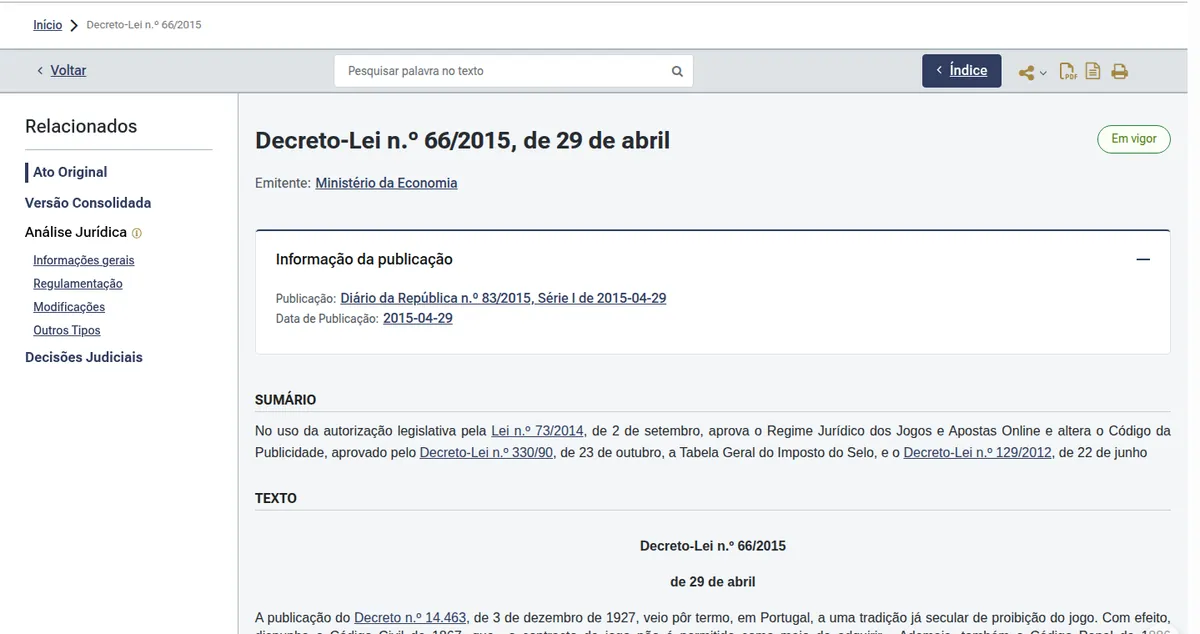
The decree-law that enacted the Regime Jurídico dos Jogos e Apostas Online, published in Diário da República n.º 83/2015 and in force since 29 June 2015. Articles 49.º, 57.º, 58.º and 61.º, quoted across this site, all sit inside it.
Free, no-deposit and bonus: three labels conversation merges
Free is the demonstration mode described above. There is a real-balance account in none of it, there is a prize in none of it, and at a licensed operator a prize is legally impossible.
No deposit is another thing: the account exists, it has a real balance attached, and the player has put down nothing. From the first second it is a serious account, carrying the identification duties that go with one.
Bonus is the label the documents use to regulate the second. Underneath it sit the rules that decide whether a win leaves the building, rather than underneath the word “free”.
Confusing the three suits whoever is advertising: “free” attracts better than “bonus with wagering requirements”, and describes what is on offer worse. What separates the three is always the same moment — the payout request — and the clauses governing it sit in free online casino with no deposit.
Even a ten-euro credit falls under the regulator’s bonus rules
On bonuses, the SRIJ has published signed and dated guidance that almost nothing published on the subject cites. We read the PDFs on the regulator’s site on 02.09.2026.
Crediting waits for the player to say yes. Orientação n.º 3/2017/SRIJ/JO, of 20 October, writes that the bonus amount «não poderá ser creditado automaticamente na conta do jogador sem que este declare expressamente, e para cada bónus, a vontade em usufruir do mesmo»: automatic crediting is permitted only where the player expressly declares, for each bonus separately, the wish to take it. One bonus, one consent — because each carries requirements the player then has to meet.
A bonus gets played, rather than withdrawn. The same document invokes Regulamento n.º 903-B/2015, of 23 December: the technical gaming system must ensure that credited bonuses serve for play alone and convert into cash for nobody. In exchange it fixes a guarantee on the other side: the prize from a winning bet placed purely with real balance may be subject to restriction, condition or term of any kind in no case, and in a bet placed with real balance and bonus at once, the share of the prize matching the real balance enjoys the same protection. Failure to comply is classed as a very serious administrative offence by the operating entity.
Self-set limits count the bonus. Orientação n.º 2/2017/SRIJ/JO, of 27 September, clarifies that bonus credits correspond to stakes placed and that the daily, weekly or monthly limits a player sets for themselves include those credits. Without that, a self-set limit would be sidestepped by whoever offered it.
Notice what the three rules share: the size of the offer is mentioned in none of them. They speak of consent, of convertibility and of counting — and that is where a bonus decides what it is worth, rather than in the number on the poster.
What we know about demonstration at the ten houses in the table: nothing
That is worth saying before anything else. The document library this site rests on was built to answer four questions: the licence claimed, the verification clause, the payout ceiling and the restricted-country list. Demonstration mode is an empty column rather than an empty cell — a column nobody ever created.
So you will find nothing written here about this or that house having free play, how many games it offers in demonstration, or whether an account is needed to reach it. We failed to read it, and such a claim copied from a campaign page reproduces an advertisement instead of reporting a verified fact.
What we do know, recorded with a clause number, is what happens once it stops being free. Wild Fortune requires identification before play from anyone using bitcoin. Rocketpot checks above 2500 USD and caps payouts at 5000 USD a month. Bitcasino.io sets 2500 EUR and a weekly ceiling of one million USDT. And Vave pays requests above 50 000 USDT in instalments spread across up to thirty days.
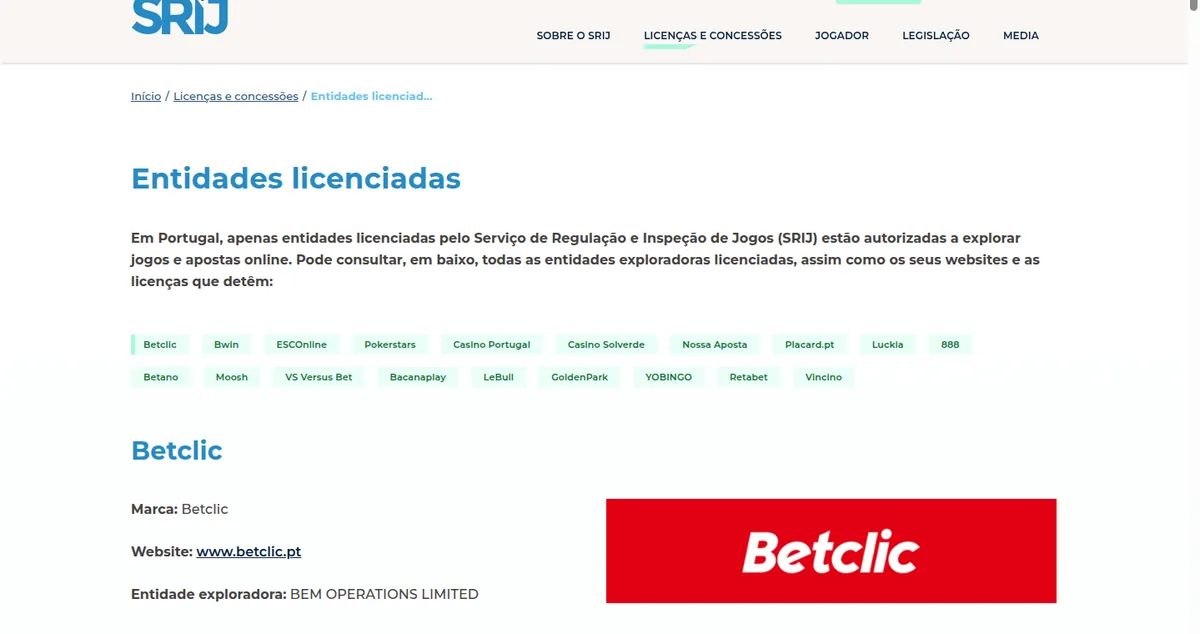
We counted 19 holders in this register, all of them on .pt addresses, and a recount on the 2nd returned the same 19 — with 17 sites a player can open, because Moosh has its activity suspended and the Vincino address carries the words «brevemente disponível», available shortly. Portugal publishes no matching list of blocked sites: this closed list is the only one the regulator keeps, and a domain is checked against it.
A demonstration session on a site outside the register
Here what is written has to be kept apart from what is unwritten, because this is a subject where giving one answer too many is easy.
What is written: article 58.º speaks of «a prática de jogos e apostas online em sítio na Internet de entidade que não esteja licenciada», the playing of online games and bets on the website of an unlicensed entity. And the Portuguese legislator uses the phrase «jogos e apostas online de demonstração» in paragraph 8 of article 37.º, treating demonstration as a species inside the genus. That is an observation about the text, and it is the whole of what the text yields.
What is written in none of the documents we managed to open: whether a demonstration spin, free of money and with a prize impossible, falls inside that rule. We found decision, guidance or note from the regulator on the point nowhere, and we settle it here by our own deduction in no way — our deduction is neither law nor protection for anybody.
What is certain, and depends on interpretation in no respect: opening an account is other than demonstration, and depositing is further still. From the moment a real-balance account exists at a site absent from the register, article 58.º applies beyond doubt, with the 2500 € ceiling of point c) of article 61.º. The arithmetic behind the two figures circulating about that value sits in the player’s fine.
What an account asks for even when it asks for no money
Putting the two sides’ registration demands next to each other is worth the space, because the word “free” usually hides this step.
At a licensed operator, article 37.º requires the registration to hold full name, date of birth, nationality, occupation, address, civil identification or passport number, tax number, email and the details of the payment account. And it stops the registration taking effect before identity has been verified and the absence of a bar on playing confirmed. It is a lot, and it is the price of having somebody to complain to.
At an operator outside the register, what applies is the drafting of that house’s terms. Six of the ten we read reserve the right to ask for papers whenever they choose, with a figure stated nowhere — DuckDice, Metaspins, Rainbet, Wolf.bet, Bitsler and Wild Fortune itself. A clause without a number triggers as readily at 20 € as at 2000 €.
This compares who wrote the rule rather than the quality of either side: in one case a public statute, in the other a contract drafted by the counterparty.
Where to ask for help, if the urge to play has stopped feeling like a choice
Free play is, for many people, the way in — and it is the one point on this page that falls outside the law. Linha 1414 is free and anonymous and answers on weekdays from 10 to 18; who runs it and what it does sit in where to ask for help.
The quotations on this page come from the official consolidation of Decreto-Lei n.º 66/2015 published as a PDF by the regulator, version of 31 March 2020, and from guidance notes 1, 2 and 3 of 2017 from the SRIJ, all read on 2 September.