
Article 5.º, paragraph 1, point c)
Online casino games: Portuguese law names them one by one
A search for online casino games gets an unusual answer in Portugal: the decree-law itself enumerates the authorised games, from baccarat to the roulettes. And a licence is worth only the categories granted to that entity, rather than everything.
A search for online casino games returns, almost always, operator catalogues. The Regime Jurídico dos Jogos e Apostas Online answers another way: it enumerates the authorised games, each with its own name, inside the article that defines what may be licensed. Anybody wanting to know whether one particular game sits on the authorised side has a list to consult rather than an interpretation to make.
The enumeration sits in article 5.º, and starts with the categories
Paragraph 1 splits the subject in three:
As categorias de jogos e apostas online cuja exploração é autorizada são as seguintes: a) Apostas desportivas à cota; b) Apostas hípicas, mútuas e à cota; c) Jogos de fortuna ou azar […]
In English: the categories of online games and bets whose operation is authorised are the following: a) fixed-odds sports betting; b) horse-race betting, pool and fixed-odds; c) games of fortune or chance.
An online casino is point c). Betting occupies the other two, and it is a separate matter: a house authorised for sports betting stays unauthorised to run slots.
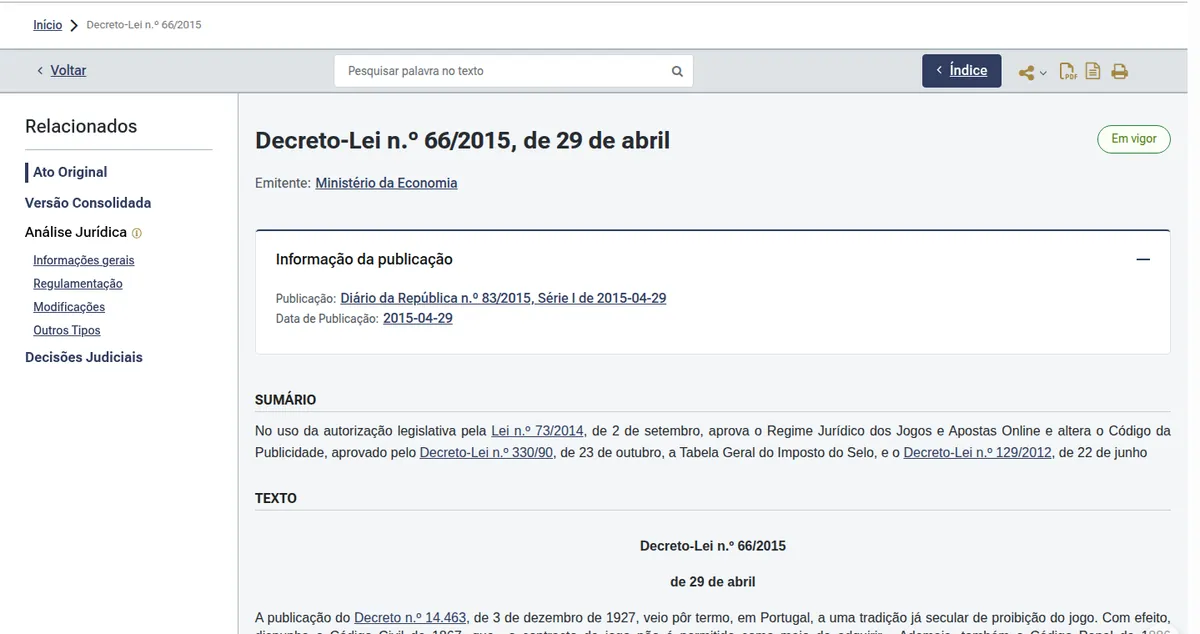
The decree-law that enacted the Regime Jurídico dos Jogos e Apostas Online, published in Diário da República n.º 83/2015 and in force since 29 June 2015. Articles 49.º, 57.º, 58.º and 61.º, quoted across this site, all sit inside it.
The games named inside point c)
Inside that point the decree-law writes them out one by one, with the names used on the floor:
- baccarat punto banco and Macau baccarat
- banca francesa
- blackjack, or 21
- bingo
- machines with three or more spinning reels, which everybody calls slots
- poker in tournament mode
- non-banked poker, including omaha, hold’em and synthetic poker
- poker without discard
- American roulette and French roulette
The definition of slots is the one that surprises a first-time reader, because it is mechanical. The law speaks of «jogos de máquinas compostos por três ou mais rolos giratórios», machine games composed of three or more spinning reels. It describes the object rather than the theme, the brand or the screen. That is why the enumeration still works decades after the machines turned into software.
The list is closed, and only the regulator can open it
Paragraph 2 of the same article leaves a door: new types of game may come to be authorised by the Serviço de Regulação e Inspeção de Jogos. The door belongs to the regulator rather than the operator — a house adds a category by deciding to offer it in no way at all.
And paragraph 4 closes the rest in one line: «São proibidas a exploração e a prática de jogos e apostas online não regulamentados», the operation and the playing of unregulated online games and bets are prohibited. Note the pair of verbs again, operation and playing, which is what makes this decree-law differ from the common assumption that the operator alone answers. The full text of the articles that decide who answers sits in what the law says.
One category still has nobody in it
Of the three categories, horse-race betting, pool and fixed-odds, is provided for in law and we finished the register having found a holder for it nowhere. It is a legal category with an empty market.
It demonstrates what a licence is: authorisation for one concrete, bounded activity rather than a general seal of quality. And it warns about how the register gets read. The match between each entity and the categories granted to it stands one step further from the source than the names and the domains do. So we leave it unpublished. The nineteen holders we counted sit in legal online casinos in Portugal.
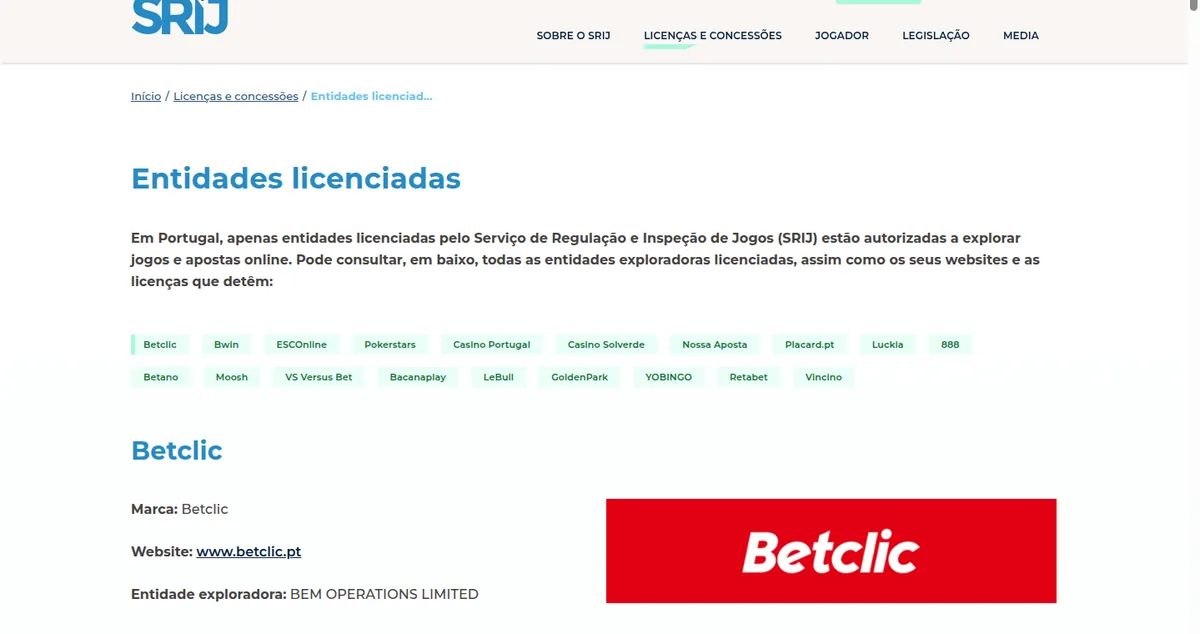
We counted 19 holders in this register, all of them on .pt addresses, and a recount on the 2nd returned the same 19 — with 17 sites a player can open, because Moosh has its activity suspended and the Vincino address carries the words «brevemente disponível», available shortly. Portugal publishes no matching list of blocked sites: this closed list is the only one the regulator keeps, and a domain is checked against it.
Game counts are absent from our library; the studios are in it
On the side of houses without a Portuguese licence, the most published comparison is catalogue size: two thousand games, five thousand, ten thousand. That total appears in no field of our library, at none of the hundred operators — it is a column that was never created rather than a cell left empty. A number copied from a campaign page reproduces an advertisement instead of reporting a verified fact, and it ages with the advertisement.
What we did manage to read is another thing: the list of studios supplying the games. It is recorded at six of the ten houses in the table on this site. It runs from 19 names at DuckDice to 120 at Bitcasino.io. In between sit 32 at Wolf.bet, 33 at Rainbet, 41 at Bitsler and 79 at Empire.io. Altogether, 149 different studios.
The overlap says more than any total. Four studios appear in all six lists: BGaming, Evolution, Hacksaw Gaming and Pragmatic Play. Another seven appear in five of them, among them Endorphina, Nolimit City, PG Soft, Play’n GO and Spribe. It is the same roulette and the same slot in different houses, with different screens around them. A catalogue distinguishes far less than the presentation suggests.
What genuinely distinguishes them sits in the verification and payout clauses, and those are in best online casino.
The game is the same on both sides; who answers is what changes
A French roulette at a site entered on the register and the same French roulette at a site outside it are indistinguishable by their screens. The difference lives in the frame around the game rather than in the game.
On the registered side there is a Portuguese regulator to address a complaint to and a licence the operator has an interest in keeping. Outside it there is the text of the house’s terms and a foreign authority with any connection to a player here in no degree. And for the player there is article 58.º, paragraph 2: playing at a site of an unlicensed entity is a minor administrative offence, with a fine of up to 2500 € for an individual under article 61.º, paragraph 5, point c). The origin of the two figures circulating about that value sits in the player’s fine.
Where this can be confirmed
The quotations on this page come from the official consolidation of Decreto-Lei n.º 66/2015 published as a PDF by the regulator, in the version of 31 March 2020, and the enumeration sits in article 5.º, paragraph 1.