
Quoted in full, without paraphrase
Legal online casino in Portugal: four articles decide who answers
Four articles of Decreto-Lei n.º 66/2015 settle the matter, and each of them is short. They are here in full, including the one article that addresses the person playing.
An online casino is legal in Portugal when the entity operating it is licensed by the Serviço de Regulação e Inspeção de Jogos. What happens outside that condition sits in 4 short articles, transcribed below. The source is the official consolidated text the regulator keeps as a 59-page PDF, in the version of 31 March 2020.
The crime belongs to whoever operates
Article 49.º, paragraph 1, the only one that provides for prison:
Quem, por qualquer meio e sem estar para o efeito devidamente autorizado, explorar, promover, organizar ou consentir a exploração de jogos e apostas online, ou disponibilizar a sua prática em Portugal a partir de servidores situados fora do território nacional, é punido com pena de prisão até cinco anos ou com pena de multa até 500 dias.
In English: whoever, by any means and without being duly authorised for the purpose, operates, promotes, organises or consents to the operation of online gaming and betting, or makes it available for play in Portugal from servers located outside national territory, is punished with imprisonment of up to five years or a fine of up to 500 days.
Paragraphs 2 and 3 of the same article add two short lines: negligence is punishable, and so is the attempt.
Look at the verbs. Operate, promote, organise, consent to operation, make available for play. Playing is absent from the list, and it is absent by design: for the person who plays, the legislator wrote a different article, in a different chapter, with a different consequence.
Look also at the second half of the sentence. «Disponibilizar a sua prática em Portugal a partir de servidores situados fora do território nacional» is the case of a foreign operator taking Portuguese players from abroad. The legislator foresaw it expressly and pulled it inside the criminal article.
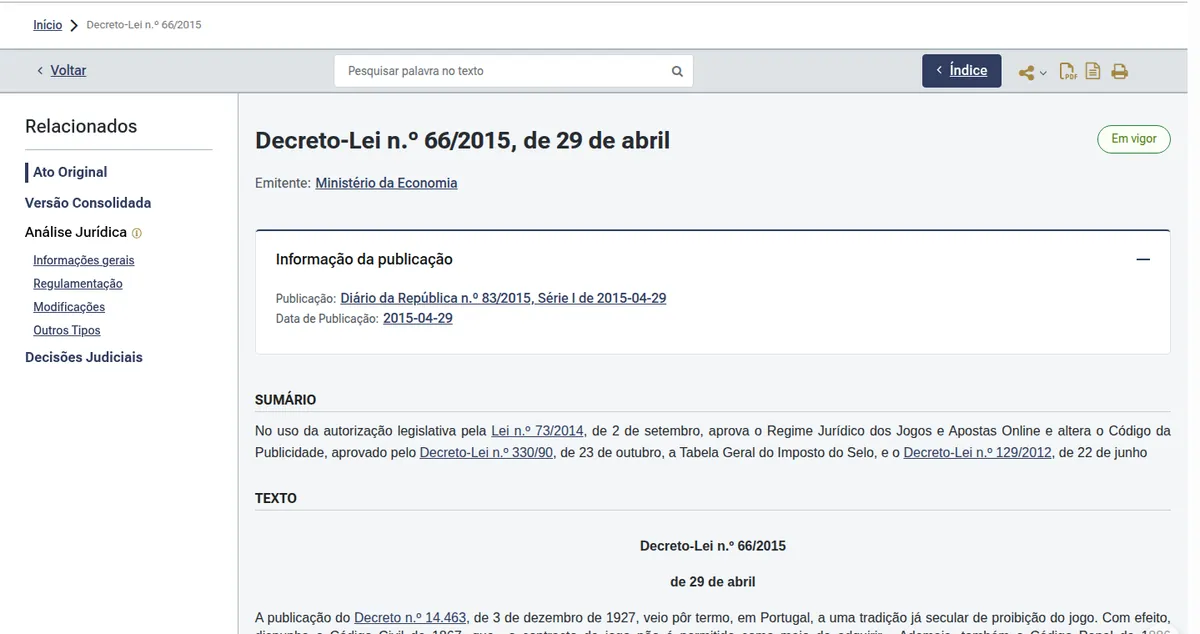
The decree-law that enacted the Regime Jurídico dos Jogos e Apostas Online, published in Diário da República n.º 83/2015 and in force since 29 June 2015. Articles 49.º, 57.º, 58.º and 61.º, quoted across this site, all sit inside it.
The administrative offence belongs to whoever plays
Article 58.º, «Contraordenações leves», minor administrative offences, paragraph 2:
Constitui ainda contraordenação leve, punível com coima, a prática de jogos e apostas online em sítio na Internet de entidade que não esteja licenciada para a exploração de jogos e apostas online.
In English: it is also a minor administrative offence, punishable by a fine, to play online games and bets on the website of an entity that lacks a licence to run such activity.
Article 59.º, paragraph 1, confirms that an individual can answer for these offences. Prison stays out of it and so does a criminal record: what remains is a fine and an administrative process.
Three word pairs that conversation merges and the statute keeps apart
Crime and administrative offence. Separate branches. The crime lives in article 49.º and carries prison as a possible outcome; the administrative offence is a regulatory sanction, free of prison and free of any criminal record. A text that treats the two as synonyms misstates what is at stake, in both directions.
Multa and coima. The «multa» of article 49.º is a criminal penalty counted in days — up to 500 of them. The «coima» of article 58.º is administrative and counted in euros. Swapping the two words is the commonest origin of the wrong figures circulating on this subject.
Operating and playing. Article 5.º, paragraph 4, writes both sides on one line: «São proibidas a exploração e a prática de jogos e apostas online não regulamentados» — the operation and the playing of unregulated online games and bets are prohibited. That sentence blocks the much-repeated reading under which Portuguese law looks at the operator alone.
Two serious cases that also reach the player
Article 57.º, on serious administrative offences, has two paragraphs pointed at the person playing.
Paragraph 3:
Constitui contraordenação grave, punível com coima, a prática de jogos e apostas online por qualquer pessoa proibida de jogar, nos termos previstos no artigo 6.º.
In English: it is a serious administrative offence, punishable by a fine, for any person barred from play under article 6.º to engage in online play and betting.
Paragraph 4 of the same article classes as serious, and as committed by the player themselves, «a perturbação do normal funcionamento e desenvolvimento dos jogos e apostas online» — interference with the normal running and course of online gambling.
Who is barred from play is set out in article 6.º, to which paragraph 3 refers and which we leave untranscribed here: anyone wanting to read it has the link to the decree-law in the footer of this page. Both situations differ from ordinary play on a foreign site, which is why the serious band answers the question on this page nowhere. That is where nearly everybody goes astray, and the arithmetic is worked through in the player’s fine.
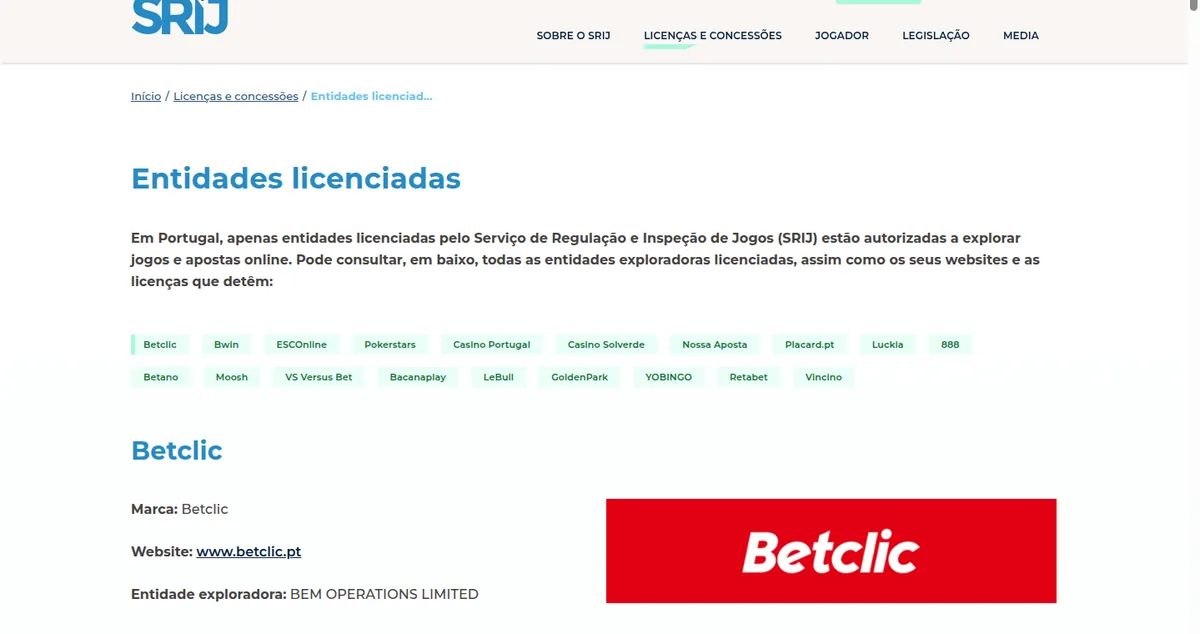
We counted 19 holders in this register, all of them on .pt addresses, and a recount on the 2nd returned the same 19 — with 17 sites a player can open, because Moosh has its activity suspended and the Vincino address carries the words «brevemente disponível», available shortly. Portugal publishes no matching list of blocked sites: this closed list is the only one the regulator keeps, and a domain is checked against it.
And the amounts, in article 61.º
No caso das pessoas singulares, as contraordenações são puníveis: […] c) Nas contraordenações leves, com coima até (euro) 2 500,00.
In English: in the case of individuals, the offences are punishable […] c) in the case of minor offences, with a fine of up to 2 500,00 euros.
Point b) of the same paragraph covers serious offences, and it is the source of the 2500 € to 25 000 € band. The two points sit three lines apart, inside the same paragraph of the same article, and that proximity explains almost all the published confusion on the subject.
Note the preposition too: «até», up to. The article fixes a ceiling rather than an amount. How much gets applied in practice, and how often, appears neither in the decree-law nor in any document we managed to read.
The authorised side is a closed list, published in legal online casinos in Portugal, and the games such a licence covers are named one by one in online casino games.
The decree-law, and what happened to it after 2015
Decreto-Lei n.º 66/2015, of 29 April, enacted the Regime Jurídico dos Jogos e Apostas Online. It appeared in Diário da República n.º 83/2015 and has been in force since 29 June 2015, a date the regulator repeats in its quarterly reports.
The cover sheet of the consolidation lists six amendments: Lei n.º 13/2017, Lei n.º 101/2017, Lei n.º 114/2017, Lei n.º 49/2018, Decreto-Lei n.º 84/2019 and Lei n.º 2/2020. That enumeration is the SRIJ’s own and we failed to confirm it in the Diário da República, whose consolidated-text page responds while returning readable text for nobody. We say so, because the alternative was to take for granted something we left unverified.
There was a seventh attempt. Projeto de Lei n.º 480/XIV/1, «Combate ao jogo ilegal», was tabled on 14 August 2020 and lapsed on 28 March 2022 without becoming law. A lapsed bill changes the law in force in no respect: the quotations above remain the applicable text, which is why they appear here without any caveat as to content.
Which file we opened, and what carries a date inside it
The document we read is the consolidation PDF hosted on the regulator’s own server, 59 pages long, with «Versão à data de 31-3-2020» on the cover sheet. Every quotation on this page comes out of it.
That brings a limit we would rather write down than hide: a consolidation dated 2020 proves by itself that nothing changed afterwards nowhere. Independent confirmation of that part failed us, and the path to each quotation is set out in how we read the documents.