
Two sources, two numbers
The player’s fine: 2500 € in the statute, 25 000 € on the SRIJ page
The legal ceiling for an individual is 2500 €. The band of 2500 € to 25 000 € that circulates everywhere belongs to a different class of offence and has a traceable origin.
Put the question in plain words and the answer arrives as 2 numbers that disagree: 2500 € from the decree-law, 2500 € to 25 000 € from the regulator’s page. This page shows where each of them comes from, because a factor of ten separates them and the whole difference lands on the person playing.
The arithmetic that comes out of the decree-law
Two rules, in this order.
Article 58.º, paragraph 2, classes play on the site of an unlicensed entity as a minor administrative offence. It is the lowest of the three classes the Regime Jurídico dos Jogos e Apostas Online uses.
Point c) of article 61.º fixes the amounts for individuals: «Nas contraordenações leves, com coima até (euro) 2 500,00» — in the case of minor offences, with a fine of up to 2 500,00 euros.
Minor plus point c) caps the fine at 2500 €. It is a ceiling rather than a fixed amount: «até» means up to. The full text of both rules, free of paraphrase in between, sits in what the law says.
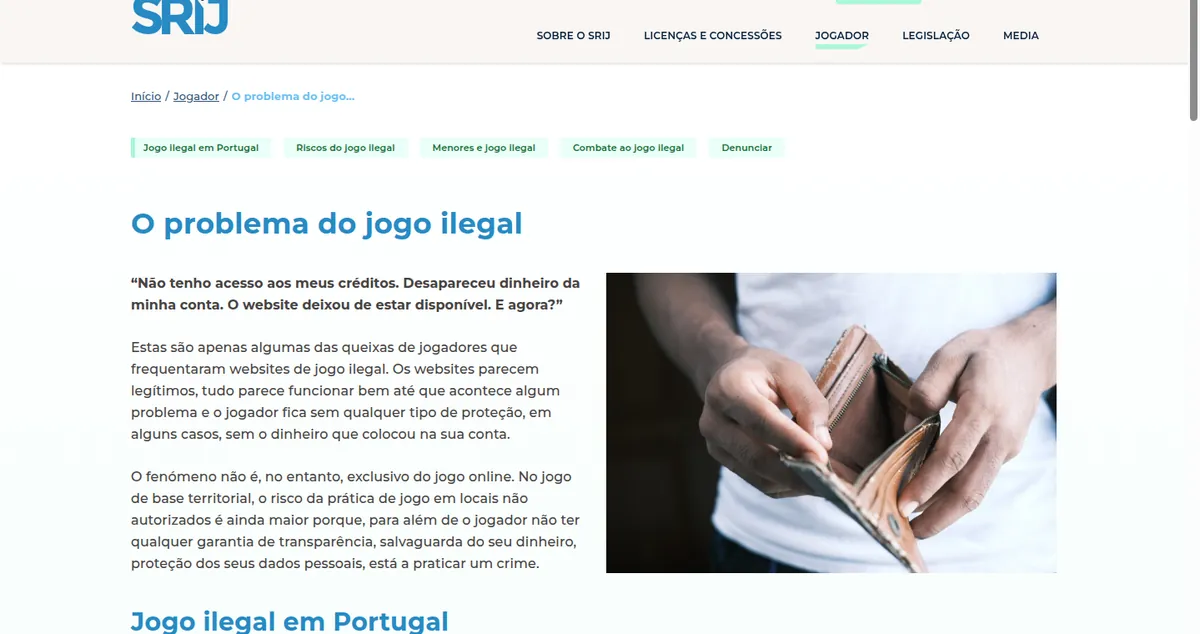
The 2 500,00€ to 25 000,00€ band attached to online play comes from this regulator page. Inside Decreto-Lei n.º 66/2015 that band belongs to serious offences, in article 61.º, paragraph 5, point b, while playing on an unlicensed site sits in article 58.º, paragraph 2, among the minor ones, with a ceiling of 2500 € under point c.
The arithmetic that comes out of the SRIJ page
The Serviço de Regulação e Inspeção de Jogos keeps a page titled «O problema do jogo ilegal», the problem of illegal gambling. On the sanction, it writes:
Sanção: poderá sujeitar-se a penalizações legais, no jogo de base territorial, com pena de prisão até 6 meses e multa até 50 dias e no jogo online contraordenação com coima de 2 500,00€ a 25 000,00€.
In English: sanction — you may be subject to legal penalties: in land-based gambling, imprisonment of up to 6 months and a fine of up to 50 days; and in online gambling, an administrative offence with a fine of 2 500,00€ to 25 000,00€.
That band genuinely exists in the decree-law — it sits in point b) of that same fifth paragraph, and it applies to serious administrative offences. Playing on an unlicensed site falls outside the serious class: article 58.º places it expressly among the minor ones.
Serious means other things, and article 57.º names them: playing while barred from play under article 6.º, and interfering with the running of the game. Somebody who opens a foreign site and spins a slot is described by neither.
We are correcting the regulator nowhere, and we hold zero authority to do so. We are saying which source each number comes from, so that a reader can go and look.
The prison in the same sentence belongs to a different law
The mention of «pena de prisão até 6 meses e multa até 50 dias» is attached, inside the regulator’s sentence, to jogo de base territorial — land-based casinos and in-person play, the subject of Decreto-Lei n.º 422/89. It comes from outside the RJO and reaches online play in no way at all.
A reader going quickly takes prison for the online player away from that sentence. The sentence says something else, and the order of its clauses is the only thing separating the two readings.
Why almost every Portuguese text prints the larger number
Because copying the summary is easier than opening the decree-law. The regulator’s page ranks well, runs short and carries a sentence that looks built for quoting; article 61.º sits inside a 59-page consolidation PDF, and finding point c) requires knowing in advance that point c) is there.
The result is a chain of copies where each link is honest and the whole is wrong. We found the serious band presented as the player’s ordinary sanction in texts that name the article it comes from nowhere — and that is always the tell: a figure with no article beside it can be checked by nobody.
The rule we imposed on ourselves is simple and written down in how we read the documents: a value enters here with the number of its rule glued to it, or it stays out.
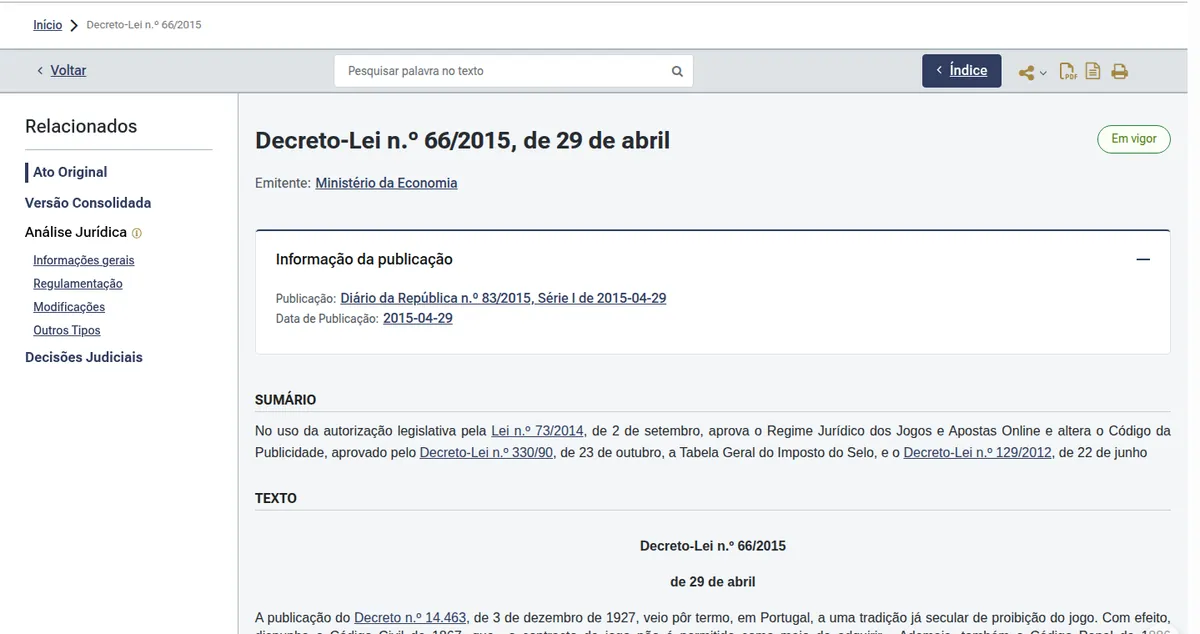
The decree-law that enacted the Regime Jurídico dos Jogos e Apostas Online, published in Diário da República n.º 83/2015 and in force since 29 June 2015. Articles 49.º, 57.º, 58.º and 61.º, quoted across this site, all sit inside it.
How many fines have been issued to players
We have no idea, and that is a better answer than the alternative.
What the regulator publishes each quarter are figures from the operator side: up to 30 September 2025, 1575 notifications to illegal operators, 2631 blocking requests and 54 referrals to the public prosecutor. Cases against players are counted by none of those numbers, and one of them turns into another by approximation nowhere.
We also skip the sentence, common on the first page of results, that in practice fines are issued to players never. It may well be true. We managed to verify it in no document, and a claim about how a regulator behaves needs more than the habit of repeating it.
So what stands is what is written: a rule describing the conduct, a limit of 2500 € on an individual, and article 59.º confirming that an individual answers for these offences.
The other risk carries figures, and it starts outside the law
The fine carries a published ceiling. Money deposited at a house outside the register obeys private documents, and there the ceilings either exist or stay unknown.
Of the ten houses we read, three publish a figure above which papers get requested: 2500 USD at Rocketpot, under clause 11.4, with 30 calendar days to hand them over; 2500 EUR at Bitcasino.io, under 6.6; 2000 USDT at Empire.io, under 5.4. The other seven reserve the right to ask whenever they choose, with a figure stated nowhere.
On the payout side, three also publish a limit: 5000 USD a month at Rocketpot, clause 11.5; 15 000 EUR a month at Wild Fortune, clause 11.8; one million USDT a week at Bitcasino.io, clause 6.10. For the rest we recorded no ceiling, which means we failed to read one — rather than that one is absent.
The two things are worth putting side by side. The legal risk is a known number with a checkable origin. The money risk is, in most cases, a clause without a number written by the counterparty. The four columns sit in best online casino, and on the other side stand the 19 entities of the register, in legal online casinos in Portugal.
What this changes for somebody deciding
It changes the kind of risk rather than its absolute size.
The player risks no prison. They risk an administrative fine reaching 2500 €, and they risk what comes from outside the law: money stuck at an operator that answers to nobody here, a limit that surfaces on the day of the first large request, a verification clause with an unwritten figure.
And if the decision has stopped feeling like a decision, the number to dial is 1414, free and anonymous — with the conditions set out in where to ask for help.