
Article 58.º, paragraph 2, quoted in full
Legal online casino in Portugal: 19 on the register, 17 open today
This site is named after a phrase, and in Portugal the phrase means one concrete thing: houses absent from the SRIJ register, however good the paperwork they hold somewhere else. We counted 19 entities on that register on 2 September 2026, every one on a .pt address, and 17 of them open for a player today. Outside the list, article 58.º, paragraph 2, of the RJO treats the act of playing as a minor offence in administrative law, with a ceiling of 2500 € for an individual.

An editorial illustration, not a screenshot. 18+ · the bonus conditions are in the operator's terms.
The first page of search results answers this in three ways that cannot all be true at once: one says the online gambling law addresses operators alone, another puts fines of 2500 € to 25 000 € on the player, a third skips the subject. None of the three cites an article. The article exists, it has a number, and it is transcribed word for word further down.
| Casino | Licence | Company | Open |
|---|---|---|---|
| Vave | Curaçao Gaming Authority | Latcas B.V. | Play at an online casinoRead |
| Vave pays for the one link that leaves this site, and that is the whole of our commercial relationship with it. The cashier takes 90 coins, headed by BTC, ETH and USDT, and has a Changelly buy-crypto step built in, so a reader who arrives without a wallet still gets through the door. We read the licence number ourselves on 2 September 2026 in the register of the Curaçao Gaming Authority: OGL/2024/1676/0905, holder Latcas B.V., issued 19 May 2025, status active. | |||
| Rocketpot | Curacao | Danneskjold Ventures B.V. | Play at an online casinoRead |
| Bitcasino.io | Curaçao Gaming Authority | Moon Technologies B.V. | Play at an online casinoRead |
| Wild Fortune | Anjouan Gaming Board | Metlait SRL | Play at an online casinoRead |
| DuckDice | Anjouan Gaming Board | Zentari Limitada | Play at an online casinoRead |
| Empire.io | Anjouan Gaming Board | Pixel Entertainment Limited | Play at an online casinoRead |
| Metaspins | Curaçao Gaming Authority | Metaspins N.V. | Play at an online casinoRead |
| Rainbet | Anjouan Gaming Board | RBGAMING N.V. | Play at an online casinoRead |
| Wolf.bet | Government of the Autonomous Island of Anjouan, Union of Comoros | Cipher Games Ltd | Play at an online casinoRead |
| Bitsler | Curaçao no number given | Oyine N.V. | Play at an online casinoRead |


Legal means one thing here, and it can be checked
An online casino is legal in Portugal when the entity operating it holds authorisation from the Serviço de Regulação e Inspeção de Jogos. Everything else stays outside the definition: the number a house displays from another country, the currency at its cashier, the payout speed it promises.
On the official register we counted 19 holders, every address ending in .pt, and the list sits in legal online casinos in Portugal. Verification runs through that list and through that list alone: Portugal publishes zero public catalogue of the sites the regulator has asked to have blocked, so the only question with a closed answer is the reverse one — does this domain appear among the licensed?
The body that keeps the list is a small service inside a large house. The SRIJ works within Turismo de Portugal, I.P., with technical and functional autonomy and with public powers of its own granted by article 45.º of the Regime Jurídico dos Jogos e Apostas Online. The law hands it licensing, inspection and the blocking request, and everything presented on this site as the position of the Portuguese State comes from it.
The list exists because a statute orders it, rather than out of administrative habit. The fifth paragraph of article 47.º requires the regulator to «criar, manter atualizado e divulgar um registo das entidades exploradoras de jogos e apostas online e dos respetivos sítios na Internet» — to create, keep updated and publish a register of the entities operating online games and bets and of their websites. The practical step that follows from it is described in how a legal online casino is confirmed.
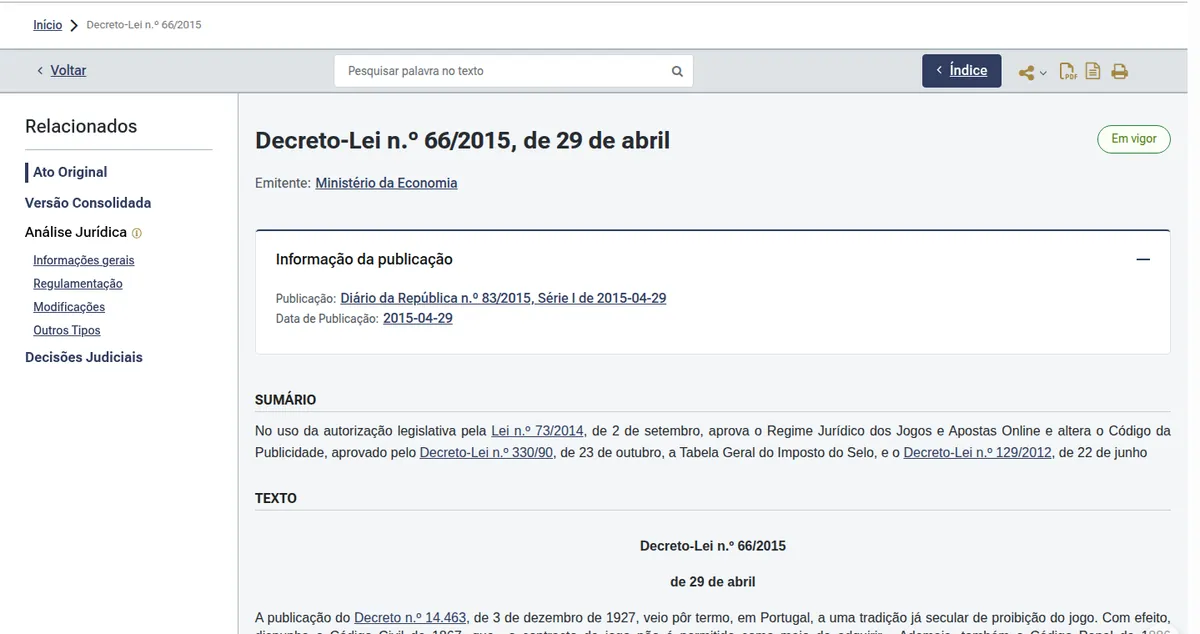
The decree-law that enacted the Regime Jurídico dos Jogos e Apostas Online, published in Diário da República n.º 83/2015 and in force since 29 June 2015. Articles 49.º, 57.º, 58.º and 61.º, quoted across this site, all sit inside it.
Nineteen, eighteen or seventeen: four numbers off one register
We opened the register again on the date that signs this page, because the count sits in its title and because the first page of results says something else. The press houses at the top write “17 online casinos licensed by the SRIJ”. They are right. They are counting a different thing, and each of them leaves unsaid which thing.
These are the four numbers that come off the same page, all of them verifiable by anyone who opens it:
Nineteen entities. The number of registered operating entities, each with a brand, a domain and a holding company. All nineteen are licensed for casino play — in the wording of the decree-law, jogos de fortuna ou azar, games of fortune or chance. Every one of them has more than betting alone.
Thirty-three licences. The number of licences in force listed beside those entities, among the numbers 001 to 020 and 023 to 035. Numbers 021 and 022 are missing from the list, and the register explains the gap nowhere — we record it as a hole in the numbering, rather than as a conclusion. Most of the licences carry endorsements attached to them, and an endorsement differs from a fresh grant: it extends the term, adds a type of game, changes the registered office or the domain name.
Eighteen with the casino open. Moosh, of Caravel Entertainment Limited, holds licences 019 and 020, both marked «a exploração da atividade referente a esta licença está temporariamente suspensa a pedido da entidade exploradora» — the activity under this licence is temporarily suspended at the request of the operating entity. It is the only entity with its whole operation stopped.
Seventeen that open today. Vincino, of Play Jogo Limited, joins Moosh: it holds licence 035, the casino one, and the register prints «www.vincino.pt (brevemente disponível)» beside the address. Licensed, then, and still short of an open door.
Two partial suspensions stay outside this arithmetic, and saying so matters, because that is exactly the kind of detail that makes somebody else’s count diverge from ours. Nossa Aposta has licence 012 suspended, which is the sports betting one; the casino licence, 011, carries a clean entry. At Luckia the same happens with 014. In both cases the casino remains listed as active.
The two most recent arrivals are Retabet Portugal, S.A., with licences 033 and 034, and Play Jogo Limited, with 035. They are the only ones without a single endorsement, which fits a recent issue date. As for the exact date of issue, the register keeps it unpublished: we invent none here, and whoever wrote a specific month took it from somewhere other than this source.
The register page was dated 3 August 2026 on the day we read it. That is the stamp the State puts on it, and it counts for more than ours. The detail entity by entity sits in legal online casinos in Portugal.
Casinos sem licença: the phrase in the domain, and what it means against the register
This site is called casinossemlicenca.com, and the phrase misleads anyone who takes it literally. It describes houses absent from the Portuguese register, rather than houses lacking authorisation altogether: every house in the table above displays one, issued in Curaçao or on Anjouan, and four of them lead to an individual certificate in the register of the body that issued it. Absence from the Portuguese register is the only reading with legal effect on this side of the border.
The difference is one of rule, rather than of degree. Article 5.º, paragraph 4, closes the door in a line: «São proibidas a exploração e a prática de jogos e apostas online não regulamentados» — the operation and the playing of unregulated online games and bets are prohibited. A foreign permit is a genuine document before the authority that issued it, and it still counts for nothing here. The practical consequence gets measured on the day something goes wrong: outside the register there is a Portuguese regulator at the far end of a complaint for nobody, and what remains is the text of the house’s own terms.
Who answers outside the register, and under which rule
Decreto-Lei n.º 66/2015 enacted the Regime Jurídico dos Jogos e Apostas Online. Article 58.º is headed «Contraordenações leves», minor administrative offences, and its paragraph 2 says, word for word:
Constitui ainda contraordenação leve, punível com coima, a prática de jogos e apostas online em sítio na Internet de entidade que não esteja licenciada para a exploração de jogos e apostas online.
In English: it is also a minor administrative offence, punishable by a fine, to play online games and bets on the website of an entity that lacks a licence to operate online games and bets.
The subject of that sentence is the person playing. It reaches past the operator, past the payment intermediary, past the internet access provider. An administrative offence differs from a crime: a fine is paid, prison stays out of it, and the process is administrative. The crime is reserved for whoever operates, in article 49.º, and the four articles that decide the whole matter appear in full in what the law says.
Portugal is an exception on this point. Most European online gambling regimes describe the operator’s side alone, so a reader who brings that assumption from another country brings a wrong one.
Where the regulator parts from the decree-law, and why the gap is tenfold
The SRIJ keeps a page about illegal gambling where it writes that the sanction in online play runs from 2 500,00€ to 25 000,00€. That band genuinely exists, and it belongs to the serious administrative offences, fixed in point b) of paragraph 5 of article 61.º. Playing on an unlicensed site sits elsewhere: article 58.º places it expressly among the minor ones, and for those, point c) of the same paragraph caps the fine for an individual at 2500 €.
We correct the regulator nowhere, and we hold zero authority to do so. We show where each number comes from, so that a reader can go and look at both. The full arithmetic, including the mention of prison that appears in the same regulator sentence and belongs to land-based gambling, sits in the player’s fine.
Article 42.º explains why every crypto house stays off the register
This is the rule missing from almost everything published on the subject, and it closes the question that brings many readers here. Article 42.º of the RJO says:
Nas operações de jogos e apostas online apenas são admitidos instrumentos de pagamento eletrónicos que utilizem moeda com curso legal em Portugal.
In English: in online gaming and betting operations, only electronic payment instruments using currency that is legal tender in Portugal are admitted.
The next paragraph tightens it: the instrument has to be supplied by a payment service provider authorised by the competent authorities of its own country, and it has to allow «a correta identificação do ordenante da operação de pagamento», the correct identification of the person ordering the payment. The third paragraph bars the operator from lending money to a player or from providing the means for players to lend to each other.
Bitcoin is legal tender in Portugal for nobody. Neither is ether, neither are the various USDT. From that follows a conclusion that is neither an opinion nor a judgement about cryptocurrency: a house whose cashier accepts crypto-assets alone falls outside that line for as long as the cashier stays that way. The SRIJ has refused it nowhere; the payment instrument it works with simply sits outside the rule a licence obliges it to meet.
Seen from there, the table on this page holds together to the end. All ten houses listed work in cryptocurrency and all ten are absent from the register. Where the documents let us read the coin list, it runs from eight at Metaspins to thirteen at Rocketpot and Wolf.bet, with 90 announced by Vave.
And it needs saying what this fails to mean. A house in cryptocurrency is worse than a house in euros nowhere in this text: it stands under a different regime, with a different authority at the other end, and the protection described in the articles that follow in the RJO travels with it nowhere.
What the State charges whoever enters the register
The price of entry is worth looking at, because it explains why nineteen names cover an entire market.
The deposits. Before operating, the applicant entity lodges two guarantees with the SRIJ: 500 000 € securing compliance with its legal obligations, in particular payment of the estimated balances in player accounts and of any fines, and 100 000 € securing the special online gaming tax. They come from the two points of article 18.º, and the amounts are published on the regulator’s page «Cauções taxas e impostos», dated 3 March 2026.
The fees. Set by Portaria n.º 211/2015, of 16 July, and updated by the consumer price index. At the values in force on 1 March 2026: 21 721,65 € for initial approval of the technical gaming system, plus 2413,52 € for each betting category or type of casino game; 14 481,10 € for issuing or extending the casino licence; the same 14 481,10 € for fixed-odds sports betting; 2413,52 € for bingo.
The tax. On the casino side, the special online gaming tax falls on the operator’s gross revenue at 25%, under article 89.º. On fixed-odds sports betting it falls on the amount staked at 8%, and rises to 35% where the operator’s only income is commission on bets between players: all of that in article 90.º. Assessment is monthly and the regulator does it, sending the collection document by the fifth day of the following month for payment by the fifteenth, as article 88.º requires. In return, article 87.º exempts income arising directly from the taxed activities from corporate income tax and from stamp duty.
Notice who pays. The three rules speak of operating entities and of the gross revenue of operating entities. The prize of the person playing appears in none of them. On what happens to a win obtained outside the Portuguese register we found a rule in none of the documents we opened, so we write no answer here: it is a matter for the Autoridade Tributária e Aduaneira.
And there is the reading that matters to somebody comparing two sites. Half a million euros of deposit, more than thirty-six thousand euros of initial fees and a quarter of gross revenue in tax are the cost of standing on the side where a complaint has an addressee. A house outside the register pays none of it — and owes none of it to anybody in Portugal either.
The three guidance notes on bonuses that almost nobody cites
Beyond the decree-law, the regulator publishes signed and dated interpretative guidance. Three of those notes deal with bonuses and limits, and all three are missing from the pages that hold the top of this search. We read the three PDFs on the SRIJ site in the same session that served to recount the register.
Crediting waits for the player to say yes. Orientação n.º 3/2017/SRIJ/JO, of 20 October, writes that the bonus amount «não poderá ser creditado automaticamente na conta do jogador sem que este declare expressamente, e para cada bónus, a vontade em usufruir do mesmo»: automatic crediting is permitted only where the player expressly declares, for each bonus separately, the wish to take it. One bonus, one consent — because each carries requirements the player then has to meet.
A bonus is played, rather than withdrawn. The same document invokes Regulamento n.º 903-B/2015, of 23 December: the technical gaming system has to ensure that credited bonuses serve for play alone and convert into cash for nobody. And it fixes the trade: the prize from a winning bet placed purely with real balance may carry restriction, condition or term of any kind from nobody, and in a bet placed with real balance and bonus together, the share of the prize matching the real balance is equally protected. Failure to comply is a very serious administrative offence.
A player’s own limit counts the bonus. Orientação n.º 2/2017/SRIJ/JO, of 27 September, clarifies that bonus credits correspond to stakes placed, and that the daily, weekly or monthly limits a player sets for themselves include those credits. Without this rule, a self-set limit would be sidestepped by whoever offered it.
The four rules share one geographic reach: the register. On the other side, what governs is the drafting of each house’s terms — and what we managed to read there sits in free online casino with no deposit.
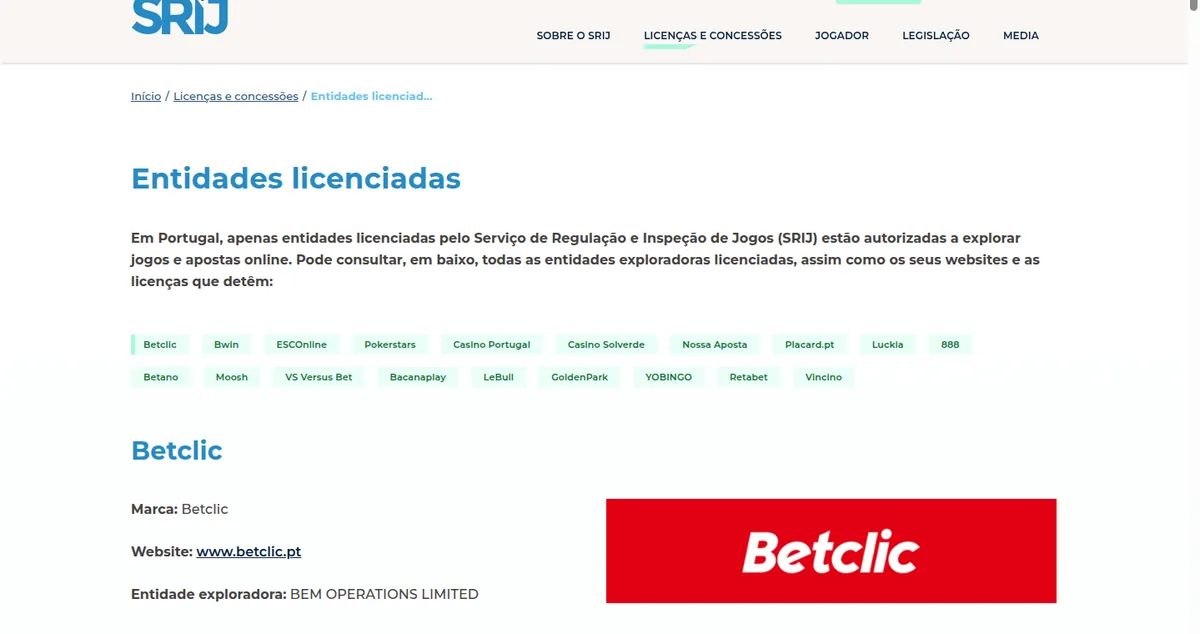
We counted 19 holders in this register, all of them on .pt addresses, and a recount on the 2nd returned the same 19 — with 17 sites a player can open, because Moosh has its activity suspended and the Vincino address carries the words «brevemente disponível», available shortly. Portugal publishes no matching list of blocked sites: this closed list is the only one the regulator keeps, and a domain is checked against it.
Self-exclusion: three months at the minimum, and one border
Article 39.º of the RJO gives the player two mechanisms and a deadline.
The first paragraph obliges each licensed site to provide means of self-exclusion. The second lets the player self-exclude at one operator, barring them from that site. The third lets them do it directly on the regulator’s site, and in that case they are barred from the sites of every licensed entity. The fourth sets a minimum of three months and lets it run indefinitely where the player names no term. And the fifth adds the piece that makes the mechanism work: notice ending a self-exclusion takes effect a month after that notice.
On the State’s side, the last paragraph of article 47.º requires the SRIJ to create and keep updated a centralised national register of players barred from play, whether voluntarily or by court order, and to make it available to the operating entities. That file is what makes a decision taken on one day hold at nineteen sites simultaneously.
So let the border be stated plainly. That register goes to holders of Portuguese licences. A site absent from the register receives it, consults it and is obliged to consult it in exactly zero respects: the protection article 39.º builds simply stops at the border. A reader who feels they need it should look for it where it exists, and the free, anonymous contact sits in where to ask for help.
Forty-eight hours: how a site is taken down
The procedure lives in article 47.º and is short. Once a site operated by an unauthorised entity is detected, the second paragraph requires the regulator to notify it to cease activity and remove the service from the internet within a maximum of 48 hours, without prejudice to the criminal liability it incurs. Once the deadline passes unmet, the next paragraph requires the intermediary network service providers to be notified under article 31.º. From there the block reaches the access provider.
The published numbers give the scale. Up to 30 September 2025, counting from the day the regime entered into force on 29 June 2015: 1575 notifications to operators, blocking requests covering 2631 sites and 54 referrals to the public prosecutor. In the third quarter of 2025 alone: 53 notifications, 130 blocking requests and 4 referrals.
Two things show in those numbers at once. The first is that the mechanism works and gets used regularly. The second is that 2631 addresses already put up for blocking, against nineteen authorised names, make checking a site by the negative route impossible: for each name on the good list there are one hundred and forty addresses on the other side, and a list of those exists nowhere.
None of the nine restricted-country lists names Portugal
Operators publish, in their terms, the list of countries whose residents they refuse accounts to. We went to read that list at all ten houses in the table; nine of them were legible. The tenth is Vave, whose terms we read in other sections — the definitions, the general conditions and the withdrawal policy — but skipped the one dealing with countries: whether the list even exists there is unknown to us.
The nine we read vary in ways that resist intuition. Two name a single country: Bitcasino.io names Japan, Bitsler names American Samoa. The other seven run from eleven to fifty-eight names. The United Kingdom and the United States appear in seven of the nine, the Netherlands in six, Spain and France in five each, Germany, Malta and Ukraine in four.
Portugal appears in none of them. That is more than an oversight by whoever drafted the documents: across the whole library of 100 operators we managed to read 38 such lists, and 14 of them name Portugal expressly. These ten houses fall outside those fourteen.
And a list that omits Portugal is far from an authorisation. Licensing belongs to the State rather than to the operator; article 58.º applies to the person playing regardless of what the house wrote about countries, and a commercial document lifts a legal prohibition for nobody. What such a list says, and the whole of what it says, is that on that day that house refused Portuguese accounts nowhere in writing.
The licensed side, in the regulator’s own figures
The most recent quarter published is the second of 2026, with gross revenue up 14,4% year on year. The statement carries no absolute figures and the publications page returns the link to the file for nobody, so absolute values from that period appear nowhere here.
The most recent report we read end to end is the third quarter of 2025, and from it comes the measure that answers the question on this page: two thirds of the authorised market’s revenue arrive from the casino category rather than from betting. The total, the number of registrations and the age breakdown sit in the nineteen entities on the register.
Two of those numbers say different things. One is about scale: the licensed side is large rather than marginal, and it fits entirely into nineteen names that occupy one screen. The other is about risk: 32,4% of the quarter’s new registrations were opened by people between 18 and 24, the youngest band the law permits to play.
The questions that bring almost everybody here
A brand by name. The test takes half a minute: look for the domain on the register. We did it for the most searched licensed house, in ESC casino online, and for the most searched name outside the Portuguese list, in Leon casino online.
How the check runs, step by step. The full procedure, with what an operator has to publish on its own site and what a foreign permit proves and leaves unproven, sits in legal online casino.
One specific game. The law names them one by one, from slots to roulettes, and authorisation covers categories rather than everything: that is in online casino games.
Playing without paying. Demo mode and no-deposit credit are separate things under separate rules, and the two are pulled apart in free online casino.
Money handed over. A 10 € credit with no deposit comes with an article of the regulation glued underneath. Of that family of clauses we read one, the wagering requirement, at three of the ten houses — 100x at Rocketpot under clause 9 of its bonus terms, 30x at Bitcasino.io and 40x at Rainbet, the last two with no clause number — and what remains unread is owned up to in free online casino with no deposit.
A “best”. Four checkable columns in place of a score, in best online casino.
The ten operators in the table, one by one
Each row of the table above has a page of its own with what we managed to read in that operator’s documents — the permit claimed and where it can be checked, the verification clause with its number, the payout ceiling where one exists, and what stayed unread. None of them holds an opinion about the house, and none describes an experience of playing: we opened an account at none of the ten.
- Vave — the house announcing 90 coins, and the only one whose terms we read section by section
- Rocketpot — the two lowest figures in the table, both of them published
- Bitcasino.io — the highest ceiling we read, two orders of magnitude above the last
- Wild Fortune — the house that takes apart the phrase “without verification” on its own
- DuckDice — verifiable own games and an unwritten threshold
- Empire.io — documents read from an archive copy, and what that changes
- Metaspins — the only case where brand and holder carry the same name
- Rainbet — discretionary checks written down twice
- Wolf.bet — the weakest evidence tier of the three
- Bitsler — a documented age and clause 4.3 without a figure
Questions answered from a document
Is playing at an online casino without a Portuguese licence a crime?
How many legal online casinos exist in Portugal?
Why do other sites write 17 where this one writes 19?
Is a casino with a Curaçao or Anjouan licence legal in Portugal?
Can I deposit in bitcoin at a casino with a Portuguese licence?
How much tax does an operator with a Portuguese licence pay?
And the player — is a win taxed?
How do I self-exclude from every licensed casino at once?
Can a bonus be credited to my account without my asking?
Can a licensed casino cut my stakes because I win too much?
How does the State shut down an illegal gambling site?
How much does a Portuguese licence cost to obtain?
Is there a public list of sites blocked in Portugal?
What does a blank cell in the table on this site mean?
What you will find missing here
All ten operators in the table sit outside the Portuguese register, and from this point of view all ten are incomparable with a licensed house: the difference is one of jurisdiction rather than of quality.
There are zero stars and zero sentences claiming we tried anything: we hold an account at no operator. There is silence on getting around a block or a self-exclusion. A blank cell always means unread, rather than “unlimited”; the method sits in how we read the documents.
Anyone who feels that play has stopped being a choice will find free and anonymous support on Linha 1414, with the rest in where to ask for help.